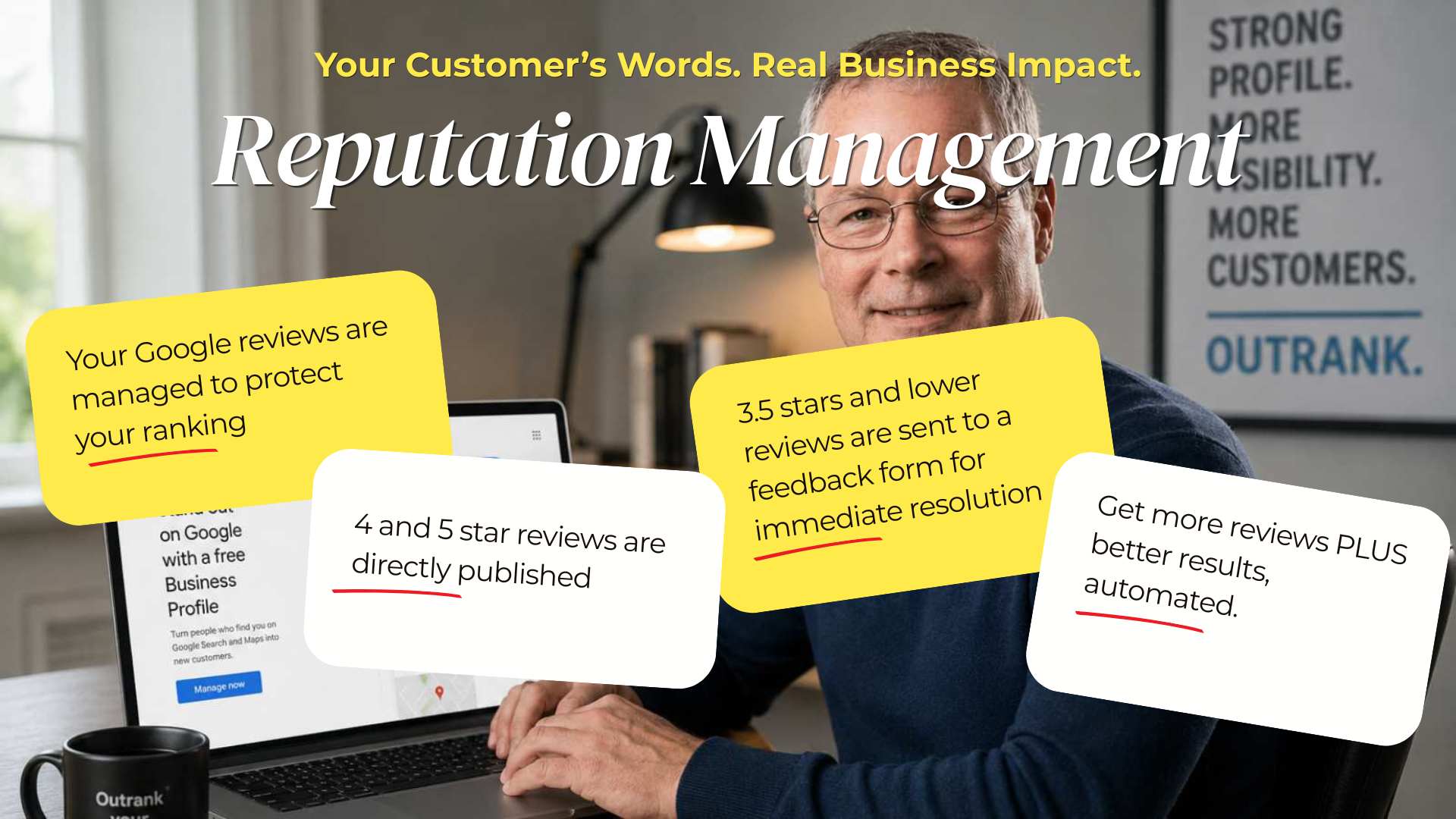

If your business serves customers in a local area, your Google reviews are one of the most important assets you own. They influence whether new customers find you, whether they trust you enough to make contact, and how Google ranks you against competitors.
Despite that importance, most small business owners manage their reviews reactively, if they manage them at all. A bad review comes in and they scramble. A good one comes in and they ignore it. The review profile grows haphazardly, and opportunities to strengthen the business’s online presence are missed every single day.
This guide covers everything you need to know to take control of your Google reviews, from the fundamentals to the advanced strategies that high-performing local businesses use to stay ahead.
Start with your Google Business Profile
Everything begins with your Google Business Profile, formerly known as Google My Business. This is the listing that appears in Google Search and Google Maps when someone searches for your business or the services you provide. Your reviews live here, and managing them starts with claiming and verifying your profile if you have not already.
If you search for your business on Google and see a listing that you have not claimed, you are leaving your online presence in the hands of Google’s automated systems and whatever information customers and competitors choose to add. Claiming your profile gives you control over your business information, photos, hours, service descriptions, and critically, the ability to respond to reviews.
Verification usually involves receiving a postcard, phone call, or email from Google with a code. The process takes a few days but it is straightforward, and there is no reason not to do it.
Understand how Google reviews affect your ranking
Google’s local search algorithm considers three primary factors: relevance, distance, and prominence. Your review profile is a major component of prominence.
The signals Google draws from your reviews include your overall star rating, the total number of reviews, how recently you have received reviews, the sentiment and keywords within review text, and whether you respond to reviews. All of these contribute to how prominently your listing appears in local search results, particularly in the map pack, which is the three-listing section at the top of local results that captures the majority of clicks.
This means that review management is not separate from your SEO strategy. It is an integral part of it. Businesses that actively manage their reviews tend to rank higher in local search, which drives more traffic, which generates more customers, which produces more reviews. The cycle is self-reinforcing when it is working in your favour.
Set up notifications so nothing slips past you
One of the simplest but most impactful things you can do is turn on review notifications. In your Google Business Profile, you can enable email alerts for new reviews. This ensures that every review, positive or negative, gets your attention promptly.
Response time matters. Customers who leave a review, especially a negative one, notice whether the business responds and how quickly. A reply within 24 hours signals attentiveness. A reply a week later, or no reply at all, signals the opposite.
For businesses that receive reviews across multiple platforms, not just Google but also Facebook, Yelp, industry-specific sites, and others, checking each one individually becomes unmanageable quickly. This is one of the primary reasons businesses adopt review management platforms that aggregate all reviews into a single dashboard with unified notifications.
Build a response strategy before you need one
The worst time to figure out how to respond to a review is in the moment after a bad one arrives. Having a response framework in place before you need it removes the emotional variable and ensures consistency.
A solid response strategy covers four scenarios.
Five-star reviews.
Thank the customer by name if possible, reference something specific about their experience, and invite them to return. Keep it warm and genuine. These responses take 30 seconds to write and they reinforce the behaviour you want to see more of.
Four-star reviews.
These are often from customers who had a good experience with one minor issue. Thank them, acknowledge the room for improvement, and express your commitment to getting it right. Four-star reviews are valuable and should be treated as such.
Two and three-star reviews.
These require more care. Acknowledge the customer’s experience without being defensive, express genuine concern about the issues raised, and offer to continue the conversation offline. Provide a direct phone number or email. The goal is resolution, not rebuttal.
One-star reviews.
Handle these with the most care. Start with empathy, not explanation. Apologize for the experience, take ownership where appropriate, and provide a clear path to resolution. Avoid arguing facts or correcting the customer in public, even if the review contains inaccuracies.
For all scenarios, keep responses concise, professional, and free of boilerplate language. Every response should read like it was written by a real person who actually read the review.
Generate new reviews consistently
The most common mistake in review management is focusing only on responding to reviews and neglecting generation. Without a steady inflow of new reviews, your profile stagnates, your rating becomes fragile (a single bad review has outsized impact when you only have a few), and Google’s signals about your relevance and activity weaken.
Effective review generation is built on three principles: timing, convenience, and consistency.
Timing.
The best moment to request a review is immediately after you have delivered great service. The customer’s positive experience is fresh, their willingness is high, and the request feels natural. Every hour of delay reduces the likelihood of follow-through.
Convenience.
The fewer steps between the request and the completed review, the higher your conversion rate. Use direct review links that open the Google review form. Put these links in QR codes, text messages, emails, and on printed materials. A two-tap process will always outperform a five-step one.
Consistency.
Review generation should not be a campaign you run when your rating dips. It should be an automatic part of every completed transaction. The businesses with the strongest review profiles are not doing anything heroic. They are doing something simple, automatically, after every single customer interaction.
Monitor your reviews across every platform
Google is the most important review platform for most local businesses, but it is not the only one. Depending on your industry, customers may also leave reviews on Facebook, Yelp, Trustpilot, Healthgrades, Houzz, BBB, HomeStars, and dozens of other sites.
Each of these platforms contributes to your overall online reputation. A great Google rating paired with a terrible Yelp rating creates confusion and erodes trust. Consistent monitoring across all relevant platforms ensures you have a complete picture and can respond appropriately wherever customers leave feedback.
For businesses that serve specific verticals, the industry-specific platforms can be particularly important. A dentist’s Healthgrades profile, a contractor’s HomeStars listing, or a restaurant’s TripAdvisor page may be the first thing a potential customer checks after finding them on Google.
Use review data to improve your business
Reviews are not just a marketing asset. They are a real-time feedback mechanism that tells you exactly what your customers think about your business. The patterns in your reviews, what people praise, what they complain about, what they mention repeatedly, are more honest than any survey you could design.
Businesses that treat reviews as data, not just reputation management, gain a significant competitive advantage. If multiple reviews mention long wait times, that is an operational issue worth addressing. If customers consistently praise a specific staff member, that is information you can use for training and recognition. If a certain service generates more complaints than others, that is a signal to investigate.
AI-powered sentiment analysis tools can surface these patterns automatically, identifying themes and trends across hundreds of reviews so you do not have to read each one individually. Monthly reports that track sentiment over time give you a clear picture of whether things are getting better or worse.
Understand what Google will and will not remove
Google has specific content policies for reviews. Reviews that violate these policies can be flagged for removal. Legitimate grounds for removal include spam and fake reviews, off-topic content, reviews that contain hate speech or personal attacks, reviews with a conflict of interest, and reviews that contain restricted or illegal content.
Google will not remove a review simply because it is negative, inaccurate in the business owner’s view, or damaging to the business. The threshold for removal is a clear policy violation, not dissatisfaction with the review’s content.
To flag a review, go to your Google Business Profile, find the review, click the three-dot menu, and select “Flag as inappropriate.” Google will review the flag and make a determination. The process can take several days and is not guaranteed to result in removal.
In cases where a review is clearly fake, coming from someone who was never a customer, you can provide additional context through Google’s support channels. Document any evidence you have and submit it with your flag.
The role of AI in modern review management
AI has changed the review management landscape in several meaningful ways.
AI-generated response drafts.
AI can analyze a review’s content, tone, and star rating, then generate a professional, contextually appropriate response draft in seconds. The business owner can approve, edit, or reject the draft before it is published. This reduces the time spent on review responses from minutes per review to seconds, making it practical to respond to every single review even for busy business owners.
Sentiment analysis.
AI can process hundreds or thousands of reviews and identify the dominant themes, both positive and negative. Instead of reading every review manually, you get a summary of what customers love and where they see room for improvement, with trends tracked over time.
AI search visibility.
A newer development is tracking how your business appears in AI-powered search tools like ChatGPT, Google Gemini, and Perplexity. As more consumers use these tools to find local businesses, understanding your visibility in AI search results is becoming an important part of reputation management.
Competitive benchmarking.
AI-powered audit tools can pull a competitor’s review data and compare it against yours, identifying gaps in rating, volume, response rate, and sentiment. This gives you specific, actionable targets rather than vague goals.
Putting it all together
Effective Google review management is not any single tactic. It is a system that covers monitoring, response, generation, analysis, and ongoing optimization. The businesses that do this well tend to share a few characteristics.
They treat review management as a business function, not an afterthought. They have someone responsible for it. They use tools that make the work efficient and consistent. And they view their review profile as a strategic asset that directly impacts revenue, visibility, and competitive positioning.
If you are a local business owner who has been managing reviews ad hoc or not managing them at all, the gap between where you are and where you could be is probably larger than you think. The good news is that the system to close that gap is straightforward, and the results are measurable.
Where to start
At Cheerful Media, we built our Reputation Manager Service specifically for the kind of business we know best: local businesses in York Region, Durham Region, and Simcoe County who depend on their online reputation to win customers.
The platform monitors reviews across 80+ platforms, generates AI-powered response drafts, runs automated review request campaigns via SMS and email, provides embeddable review widgets for your website, and delivers monthly reports that show exactly how your reputation is trending.
We start every engagement with a free review audit. We pull your current reviews, calculate your trust score, compare you to your local competitors, and show you the specific opportunities you are missing. No cost, no obligation, and you walk away with a clear picture of where you stand.
Book your free review audit today and take the first step toward making your online reputation one of your strongest competitive advantages.